You Can See Everything Nathan Fielder Lance Oppenheim Amanda Seyfried Christopher Abbott Nathan Fielder by Jason Koenigsberg About a month before infamous fraudster Elizabeth Holmes went away to serve her […]
About a month before infamous fraudster Elizabeth Holmes went away to serve her prison sentence for the Theranos scandal, she invited documentary filmmakers Nathan Fielder and his crew into their home to provide an honest portrait of her family life. What the final product of You Can See Everything delivers makes the viewer question the very definitions of honesty, truth, and turns non-fiction narrative inside out blending it with elements that make this unlike any documentary ever made. The film opens up with a man talking about Elizabeth Holmes while he is lying on his back with the camera positioned near his chin. It is revealed that this is her husband and we see Elizabeth Holmes in the next shot sitting next to him holding their baby. Right from the beginning You Can See Everything injects humor naturally throughout the documentary. Nathan Fielder, one of the directors, is on screen and becomes a major character in his portrait of one of the most notorious figures in recent American history. The humor is abundant and at times You Can See Everything feels like a long Saturday Night Live skit that fortunately never wears out its welcome. It is amazing the humor works considering that the film is made with a lot of close up shots of the subjects talking to each other and has an eerie, haunting music score throughout, making the tone of the film feel sarcastic rather than serious. The humor comes from the pauses and the candid questions Fielder asks Holmes and her husband Billy Evans. The timing is impeccable and generates genuine laughs with concise editing that never makes You Can See Everything feel long during its three hour runtime.
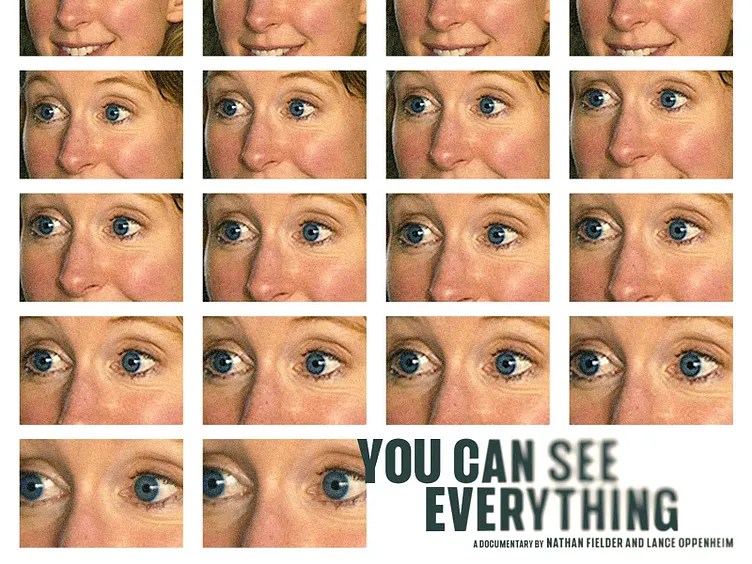
This movie brings the audience up to speed on Holmes’ scandalous background and her new family she created since becoming convicted of fraud on a grand scale. She seems convinced that she did nothing wrong and created an invention that could work and perform the blood tests she said it could. As the narrative unfolds it becomes apparent that there are questions surrounding her husband and his motivations. It also feels like there may have been some opportunity for a romantic relationship between her and Nathan Fielder as he got closer to her while filming this. The sexual tension and the humor never evaporate and the audience is never fully sure if Elizabeth Holmes is telling the truth or putting on a show for the cameras. Both her and her husband are often framed in close ups and their eyes are very wide as they speak. Some of the best moments are when Nathan Fielder is brutally honest with his questions like when he asks why she agreed to choose him to document her life and not someone with more of a science background who could have asked harder questions related to her industry, or when he asked her husband why he picked her to marry when he could have had other women. You Can See Everything has moments where it focuses very carefully on word usage. A memorable scene with her invention regarding saying ‘it can’ versus ‘it is capable of’ explaining how the former is misleading and other moments like that demonstrates that word usage has become a more prevalent topic regarding sensitivities and misinformation in recent decades than it used to be.
There is a twist in the middle of You Can See Everything that takes the second act into an unexpected meta direction for a documentary and should not be spoiled. The second half is brilliant because it makes the viewer question any and all documentaries and what they should take for the truth. It says that we are all biased even the documentaries that try so hard to not take a side always have always a bias. That is human nature. It is up to the audience to decipher what they take from You Can See Everything as the truth. The title itself is a paradox, we do see everything with Elizabeth Holmes and her family, but at the same time the audience has to decide for itself if what we are seeing is the truth.